Published


Vistage vs. YPO (vs. Long Angle): Which is Right For You?
Vistage vs. YPO (vs. Long Angle): Which is Right For You?
Deciding between Vistage vs. YPO? Assess the pros and cons of each, including commitment, leadership styles, and benefits.
Vistage and YPO solve different problems. Vistage is a structured coaching system for active operating leaders, qualifying on $5M or more in company revenue, with 12 to 16 members meeting a full day each month under a paid Chair. YPO is a selective global community for chief executives under 45, qualifying on hard revenue and workforce thresholds, with 8 to 10 peers meeting monthly under a trained member moderator. Vistage lists about $16,500 a year in dues plus an enrollment fee, and YPO runs $4,790 in international dues plus chapter dues. Neither has a personal wealth requirement.
Key Takeaways
- Vistage qualifies on company revenue of $5M or more, with no age limit. YPO requires you to be under 45 and clear a revenue, enterprise-value or AUM threshold plus a workforce test.
- Vistage lists about $16,500 a year in dues for its CEO program, plus an enrollment fee it does not publish. YPO is $4,790 in annual international dues plus a $4,790 initiation, with chapter dues on top.
- Vistage groups run 12 to 16 and meet a full day monthly with a paid Chair. YPO Forum runs 8 to 10 for three or four hours with a trained member moderator.
- Vistage centers on the operating company. YPO Forum is explicitly whole-person, covering family and personal finances alongside business.
- Neither has a personal wealth requirement, so neither guarantees peers who have faced your balance-sheet decisions.
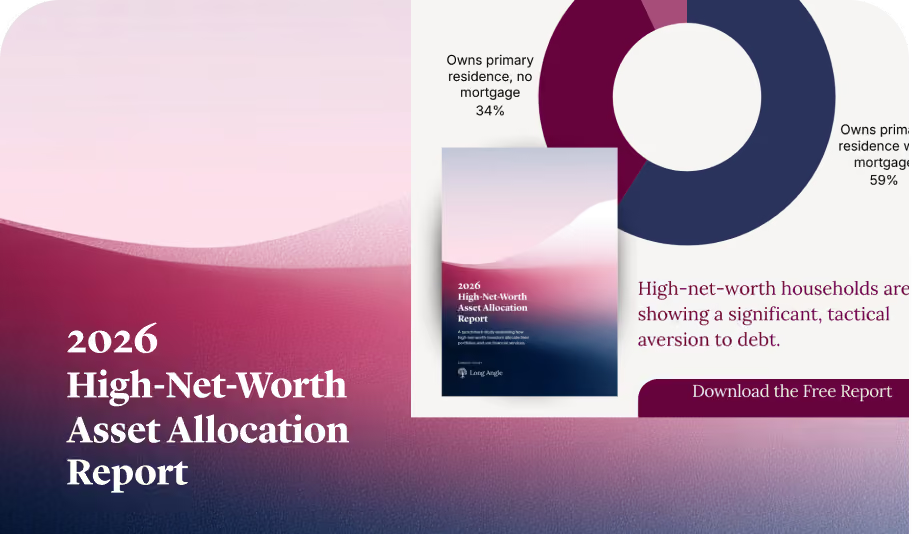
2026 High-Net-Worth Asset Allocation Report
See how high-net-worth investors with an average net worth of $17M are allocating across public equities, private markets, real estate, bonds and cash. Based on benchmark data from 230+ respondents.

Vistage vs. YPO at a Glance
YPO and Vistage are often shortlisted together and solve different problems. YPO is a selective global community for chief executives under 45. Vistage is a structured coaching system for active operating leaders.
| YPO | Vistage | Long Angle | |
|---|---|---|---|
| Qualifies on | CEO role and company scale | Company revenue | Investable assets |
| Entry threshold | Under 45, $16M+ revenue | $5M+ revenue | $3M+, excluding primary residence |
| Organized around | Leadership and life | Company performance | Wealth complexity |
| Small-group size | 8 to 10 (Forum) | 12 to 16 | 6 to 8 (Trusted Circles) |
| Cadence | Monthly, 3 to 4 hours | Monthly, full day | Monthly, 3 hours |
| Facilitated by | Trained member moderator | Paid Vistage Chair | Professional moderator |
| Minimum commitment | Annual membership | 90 days’ notice to cancel | 12 months |
| One-time initiation | $4,790 international | Not published | None |
| Annual cost | $4,790 international, plus chapter dues | About $16,500 in dues | Free to join. Trusted Circles $4,500 a year |
Source: Thresholds and dues from ypo.org, vistage.com and longangle.com/trusted-circles, read September 2026. YPO chapter dues are additional and vary by chapter. Vistage lists about $16,500 a year in dues for its CEO program and does not publish its enrollment fee. Its fees vary by program and location. Long Angle membership is free to join; the $4,500 is the Trusted Circles fee only.
Who Each One Is Built For
The qualifying tests are the clearest difference, because they determine who ends up in the room with you.
YPO applies hard thresholds and checks all of them: under 45 at application, the top operating role with final decision authority and full profit-and-loss responsibility, and a company clearing $16M in revenue for sales, service or manufacturing, $13M for an agency, $330M in AUM for a financial institution, or $27M in enterprise value. There is a workforce test too: 50 full-time employees, or 15 plus at least $2.75M in annual employee compensation.
Vistage asks for less. The flagship Chief Executive program requires you to lead a company with $5M or more in annual revenue, with no age limit. Vistage describes member companies ranging from roughly $5M to $1B+, so the range inside a group is wide and the matching process does the work the threshold does not.
Neither has a personal wealth requirement. Both qualify you on your role and the company you lead.
What Each One Costs
Vistage costs more per year. YPO costs more to join, and its real cost depends heavily on how much you travel.
- YPO: $4,790 in annual international dues plus a one-time $4,790 international initiation fee, with local chapter dues on top. Chapter dues vary widely, and some chapters add their own initiation fee.
- Vistage: about $16,500 a year in dues for the flagship CEO program, plus a one-time enrollment fee Vistage does not publish. Fees vary by program and location, so ask a Chair for the first-year figure in writing.
Sticker price understates YPO more than it understates Vistage. Forum retreats, chapter events, regional and global programs and family experiences are mostly user-pay, and a member who engages heavily can spend well beyond dues. Vistage is less travel-dependent, because the product is a recurring local meeting.
How the Groups Work in Practice
This is the difference that decides which one suits you, and it gets less attention than cost.
YPO Forum runs 8 to 10 peers meeting monthly for three or four hours, led by a trained member moderator rather than a paid professional. The method favors experience sharing over advice: members are trained to describe what they did in a comparable situation instead of telling anyone what to do. Confidentiality is a cultural ritual, and the conversation is explicitly whole-person, covering marriage, family and personal finances alongside the business.
Vistage runs 12 to 16 non-competing leaders meeting for a full working day each month, led by a paid Vistage Chair, plus a monthly one-to-one coaching session. Meetings often include an expert workshop. The center of gravity is the operating company and the member’s effectiveness as its leader.
So the choice is between peer ownership and professional facilitation, and between a room built for your life and a room built for your company.
Where Each One Falls Short
Both have failure modes worth knowing before you commit, and in both cases the local group matters more than the brand.
- YPO: chapter and Forum quality vary, and the brand does not guarantee chemistry. Total participation cost can run far past dues. An accomplished investor or exited founder may not qualify at all, because eligibility turns on an active operating role and age.
- Vistage: the Chair determines most of what you get, and Chairs are independent contractors who build their own groups. A $5M threshold admits a wide span of company size. Published terms require 90 days’ notice to cancel after the initial period.
They share one blind spot. Neither is organized around what happens after the company. YPO has a continuation path through YPO Gold; Vistage has no equivalent, and its value thins once your hardest decisions leave the business.
What the Evidence Shows
Vistage makes the stronger quantitative case. YPO makes the stronger case on access and community, which is harder to measure.
Vistage cites Dun & Bradstreet comparisons in its own materials: member companies grew 2.2x faster than comparable non-members in 2017, and in 2020 member companies grew revenue 4.6% while comparable non-members declined 4.7%. It also reports that CEO members stay more than five years on average, which is meaningful evidence of recurring utility.
Treat all of it as evidence rather than proof. Members self-select, and a leader who commits a full day a month to working on the business may differ from one who does not in ways the comparison cannot isolate. YPO publishes little comparable outcome research, which is partly a measurement problem: its value proposition is broader than revenue growth, and trust, reduced isolation and family perspective do not produce a clean number.
How to Decide Between Them
Answer two questions, in this order, and the choice usually makes itself.
- Are your hardest decisions about the company or about your life? If they are operating decisions, Vistage is built for exactly that and has the more explicit accountability structure. If they run across business, family and identity together, YPO Forum is the format designed for it.
- Do you want a coach or peers? Vistage puts a paid professional in the room whose job is to hold the structure. YPO puts a trained peer there and keeps ownership with the members. Neither is better, and people who want one are often frustrated by the other.
Then diligence the specific group rather than the brand, because on both sides the local unit determines the outcome more than the logo does. Meet the Chair or Forum moderator before committing. Ask to meet two or three current members. Ask each of them what they brought to the room in the last six months. If every answer is an operating problem and yours is not, you have learned what you needed to know before paying an initiation fee.
Where Long Angle Fits
The three ask different qualifying questions, and the answer determines who is in the room.
YPO asks whether you are an accomplished chief executive. Vistage asks whether you are running a meaningful business and want to run it better. Long Angle asks whether your wealth has become complex enough that the decisions around it are genuinely hard.
Because neither YPO nor Vistage has a personal wealth requirement, a group can be full of capable operators where nobody has faced the decision you brought. For a founder whose company has sold, or an executive whose equity has vested into a balance sheet they now have to manage, that is the gap.
Long Angle qualifies on investable assets rather than job title: more than $3M, excluding a primary residence, verified, with no upper limit. Illiquid assets count. Membership is free to join. Trusted Circles, its peer advisory format, is a separate $4,500 a year and places 6 to 8 members into a confidential group matched by life stage, net worth and goals, meeting monthly for three hours with a professional moderator and a twelve-month minimum commitment. Every member agrees to a no-solicitation policy.
If your hardest decisions are still about the company, choose between Vistage and YPO on the two questions above. If they have moved to what the company produced, neither is built for that. Some members keep their YPO Forum or Vistage group for the company and use Long Angle for the personal financial decisions the company created.
Final Thoughts
Choose on the company you run and the time you can give. Vistage suits a CEO in any industry who wants a full-day monthly group and one-to-one coaching from a Chair. YPO suits a chief executive under 45 who wants a global community and a Forum of peers. Vistage lists about $16,500 a year in dues, and YPO $4,790 in international dues plus chapter dues.
Neither has a personal wealth requirement, so neither is built around the wealth the company created. For those decisions, some members keep their Forum or Vistage group and add Long Angle, which is free to join with more than $3 million in verified investable assets, excluding a primary residence. Its optional Trusted Circles cost $4,500 a year.
Frequently Asked Questions
Can I Join YPO After the Age of 45?
While traditional membership is restricted to those under 45, YPO provides a pathway for older members to continue engagement through YPO Gold.
How Do Vistage Events Differ from YPO Conferences?
Vistage events are typically more focused on peer advisory and personal coaching, while YPO conferences are larger and more globally oriented.
Can I Join Both Vistage and YPO Simultaneously?
It is possible to be a member of both Vistage and YPO if you meet both organizations' membership criteria, providing a unique opportunity to benefit from the resources of both networks.
How Can One Assess Which Organization is the Best Fit for Their Needs?
It depends on your professional goals, budget for membership fees, and desired level of engagement. Prospective members should consider the specific benefits, costs, and community culture of each to determine the best fit.
Business peer groups rarely cover what to do with the wealth the business created.
Long Angle is a free, vetted community of founders, executives and investors who compare notes on tax, allocation, advisors and what comes after financial success, with no one in the room selling anything.
More From Long Angle
Beyond Wealth Newsletter
Navigating Wealth Podcast
Research & Studies
Alternative Investment Education
Blog